
Lake Okoboji is one of Iowa’s most treasured natural resources, and keeping its waters clean is a responsibility shared by every resident, property owner, and visitor. West Lake Okoboji, in particular, holds a special designation as an Outstanding Iowa Water, meaning it actually exceeds Iowa’s recommended water quality standards. It is also a designated source of drinking water and a premier recreational destination — supporting activities like swimming, boating, and water skiing. Preserving these exceptional conditions is not just a privilege; it is a commitment we must all take seriously.
Fortunately, protecting Lake Okoboji does not require grand gestures. In fact, many of the most impactful changes start right in your own backyard. By adopting a handful of mindful daily habits, every member of our community can play a meaningful role in safeguarding the health of our lakes for generations to come. Below, you will find ten practical and proven ways to help keep Lake Okoboji clean, along with important information about aquatic invasive species, water quality monitoring efforts, and how our community comes together to protect this remarkable place we call home.
10 Everyday Habits to Protect Our Lake
The good news is that protecting Lake Okoboji starts with small, intentional choices made every day. Whether you live on the shoreline year-round or visit during the summer months, the following habits can make a real difference in the long-term health of our waters.
1. Switch to Phosphorus-Free Fertilizers
One of the most common culprits behind poor lake water quality is lawn fertilizer runoff. When rain falls on lawns treated with phosphorus-containing fertilizers, those nutrients are carried directly into nearby waterways — and ultimately into the lake. Once there, excess phosphorus fuels the growth of harmful algae blooms that can discolor the water, deplete oxygen, and threaten aquatic life. Fortunately, the solution is simple: always choose phosphorus-free fertilizer options for your lawn.
Additionally, before you apply any fertilizer at all, consider testing your soil first. Many Iowans are surprised to discover that their soil is already healthy enough to support a beautiful green lawn without any added nutrients. Fertilizer with as little as 15 ppm of phosphorus is typically sufficient for lawn growth. To obtain a soil testing kit, you can contact the ISU Dickinson County Extension Service at (712) 336-3488. Zero-phosphorus options such as Lake-n-Lawn Saver or Renaissance are widely available at local garden centers. For an organic alternative, soybean meal is another zero-phosphorus fertilizer available at Terril Coop in Terril, Iowa, and at Fergusons in Spirit Lake, Iowa.
2. Clean, Drain, and Dry Your Boat
Every time a boat is moved from one body of water to another without being properly cleaned, it risks carrying aquatic invasive species along with it. These organisms can hitch a ride on hulls, trailers, live wells, and equipment — and even a small amount of contaminated water is enough to introduce a new species into an otherwise healthy lake. Before launching into Okoboji, thoroughly wash your watercraft at a local boat wash station, drain all water from the vessel, and allow it to dry completely. Taking this extra step not only protects our lake, but it is also the law in Iowa.
3. Always Pick Up Pet Waste
It may seem like a small thing, but pet waste left on the ground carries a significant environmental impact. Animal waste is packed with harmful bacteria and excess nutrients that, when left outside, can be washed into storm drains or directly into the lake with the next rainfall. To prevent this, always scoop up your pet’s waste promptly and dispose of it in the trash. This simple habit goes a long way toward protecting the water quality that makes Lake Okoboji so special.
4. Keep Your Septic System Well-Maintained
For properties that rely on a septic system, regular maintenance is absolutely essential. When a septic system begins to fail, it can leak bacteria and harmful nutrients directly into the groundwater that feeds the lake. Over time, this contamination can quietly degrade water quality in ways that are difficult and costly to reverse. To prevent this from happening, have your septic system professionally inspected and pumped on a regular schedule, as recommended by local service providers. Staying ahead of potential issues is far less expensive — and far less damaging — than dealing with a system failure.
5. Manage Lawn Clippings and Yard Waste Properly
Many homeowners do not realize that grass clippings and fallen leaves pose a real threat to lake health when they end up in or near the water. As organic matter decomposes in the lake, it releases unwanted nutrients that feed algae and disrupt the aquatic ecosystem. To avoid contributing to this problem, never blow or sweep lawn clippings, leaves, or other yard waste into the street or toward the shoreline. Instead, compost yard waste on your property, or bag it for proper disposal. This small change in routine can have a surprisingly large positive effect on water quality.
6. Wash Vehicles and Boats Responsibly
While washing your car or boat is necessary, where and how you wash it matters enormously. Common soaps and detergents contain phosphates and other pollutants that are harmful to aquatic life. When you wash a vehicle in a driveway, that soapy runoff flows directly into storm drains — and from there, straight into the lake without any treatment. Instead, wash your car on the grass, where the soil can act as a natural filter, or take it to a commercial car wash, where wastewater is treated before being released. The same principle applies to boats: use designated wash stations whenever possible.
7. Plant a Natural Shoreline Buffer
One of the most beautiful and effective ways to protect Lake Okoboji is to plant a natural buffer along your shoreline. A strip of native plants, trees, and deep-rooted groundcover works as a natural filter, slowing down stormwater runoff and absorbing harmful nutrients before they can reach the lake. Beyond the environmental benefits, native plantings also add natural beauty to your property and provide habitat for local wildlife. If you are considering a shoreline restoration project, contact local conservation resources for guidance on the best native species for our region.
8. Keep Storm Drains Clear of Harmful Substances
Storm drains may seem like a convenient place to dispose of unwanted liquids, but anything poured into them flows directly into the lake without any filtration or treatment whatsoever. Chemicals, motor oil, paint, and cleaning products are among the most damaging substances that end up in our waterways this way. Always dispose of hazardous materials at designated drop-off sites, and remind your neighbors and visitors to do the same. Keeping storm drains clear of harmful substances is one of the easiest and most direct ways to protect the health of our lake.
9. Reduce Your Use of Road Salt in Winter
During Iowa’s cold winters, road salt is a common solution for icy driveways and walkways — but it comes with hidden costs for our lake. Chloride, the active ingredient in road salt, is toxic to aquatic ecosystems and does not break down over time. Once it enters a body of water, it can accumulate and harm the plants, insects, and fish that depend on healthy water chemistry. To minimize your impact, shovel snow early and often so that less ice forms in the first place, reducing your need for salt. When you do apply salt, use it sparingly and consider switching to a more eco-friendly de-icer product.
10. Get Involved in Local Cleanup Efforts
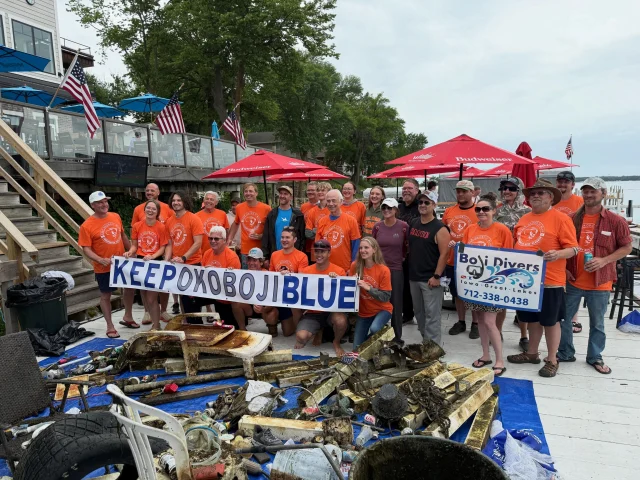
Beyond individual habits, community involvement is one of the most powerful forces for keeping Lake Okoboji clean. Participating in local beach cleanup events, for example, allows you to directly remove garbage and debris from the shores and surrounding recreation areas. Many area beaches are also equipped with Beach Clean-Up boxes stocked with supplies to make it easy for anyone to pitch in during a visit. Furthermore, if you’ve had a wonderful experience enjoying the Iowa Great Lakes area, consider making a donation to a local nonprofit organization whose programs help preserve and protect this incredible environment.
The Threat of Aquatic Invasive Species
While everyday habits like responsible fertilizing and proper waste disposal are crucial, one of the most serious and pressing threats to Lake Okoboji comes from aquatic invasive species. These are plants, animals, and other organisms that are not native to our lakes and, once introduced, can spread rapidly and cause devastating damage to the ecosystem, the local economy, and even human health. Understanding what these species are and how to prevent their spread is essential knowledge for everyone who uses or lives near the lake.
The consequences of allowing invasive species to take hold are wide-ranging and severe. Specifically, aquatic invasive species can:
- Reduce game fish populations and damage native species diversity
- Ruin boat engines and jam steering equipment
- Make lakes and rivers unusable for boaters and swimmers
- Dramatically increase the operating costs of drinking water plants, power plants, and dams
- Degrade entire ecosystems and reduce biodiversity
- Pose risks to human health
- Reduce property values for lakefront and nearby homeowners
- Devastate the local economies of water-dependent communities like ours
Three invasive species in particular pose the greatest risk to Lake Okoboji and deserve special attention.
Eurasian Watermilfoil
Eurasian Watermilfoil is a submerged aquatic plant that spreads with alarming speed. Even a tiny fragment of the plant broken off by a boat propeller or swimming can take root and grow into a new colony. What makes it especially problematic is its ability to thrive in a wide range of temperatures and environmental conditions, allowing it to quickly outcompete native vegetation by forming dense mats at the surface that block sunlight from reaching below. Once it takes hold, these thick tangles of plant matter make swimming, boating, and fishing nearly impossible — transforming a beloved lake into an unusable tangle of weeds. The resulting damage to water-dependent economies can be enormous, often resulting in costly treatment programs and higher taxes.
Zebra Mussels
Zebra mussels are another highly destructive invasive species that can attach in large numbers to virtually any hard surface in the water — including docks, boats, shorelines, and underwater infrastructure. Their sharp, razor-like shells pose a serious physical hazard to swimmers and anyone who handles contaminated equipment. Beyond the personal safety risks, zebra mussels clog the intake pipes of drinking water plants, dams, and industrial facilities, driving up operational costs that are ultimately passed on to consumers. Like other invasive species, they are also closely associated with declining water quality and the deterioration of water-dependent local economies.
Asian Carp
Asian Carp represent yet another significant threat to our waterways. After their introduction, these fish became extraordinarily abundant and caused serious harm to native fish populations by consuming vast quantities of food and degrading natural habitats. They can grow to weigh as much as 90 pounds, and certain species — particularly the silver carp — are known to leap out of the water in response to passing motorboat engines, creating a very real physical danger to boaters. As with the other invasive species described above, the economic fallout from an Asian Carp infestation can include damaged fishing industries and costly mitigation efforts for local governments and taxpayers alike.
What You Can Do to Stop the Spread
The encouraging news is that preventing the spread of aquatic invasive species is entirely within our control — provided that everyone who uses the lake takes the right precautions. In fact, it is against Iowa law to transport aquatic invasive species, making responsible boat cleaning not just a matter of courtesy, but a legal obligation. Before leaving any body of water, follow these important steps:
- Remove any visible mud, plants, fish, or animals from your boat, trailer, and all equipment before transporting it.
- Drain all water from your boat, live well, bilge, and any other compartments before leaving the area.
- Clean and completely dry anything that has come in contact with the water — including boats, trailers, clothing, and even your dog.
- Never release plants, fish, or animals into a body of water unless they were originally taken from that same body of water.
- If you spot a boat or trailer that appears to be carrying invasive species, report it immediately to local law enforcement or the Iowa DNR.
When it comes to cleaning your boat, trailer, and equipment, hot water — at least 104°F (40°C) — is highly effective at eliminating invasive organisms. Any high-pressure car wash can typically meet this temperature standard. Alternatively, a saltwater solution can also be used to clean your equipment thoroughly. Taking just a few extra minutes after each outing on the water can make a tremendous difference in protecting Lake Okoboji from these destructive invaders.
How Lake Okoboji’s Water Quality is Monitored
Protecting the lake requires not only action, but also ongoing knowledge about the current state of its waters. Fortunately, Lake Okoboji benefits from several dedicated water quality monitoring programs that keep a watchful eye on conditions throughout the year.
The Cooperative Lakes Area Monitoring Project (CLAMP) is a volunteer-based program that has been running since 1999, founded through a partnership between Iowa Lakeside Lab and Friends of Lakeside Lab. Throughout the summer season, trained volunteers collect water samples from nine lakes in Dickinson County, including Lake Okoboji. The long-term data gathered by CLAMP is invaluable for tracking algae conditions over time and educating local residents about lake ecology. In addition to CLAMP, the Iowa DNR also operates a statewide lake monitoring system that provides broader oversight of water quality across the state.
These monitoring efforts exist because West Lake Okoboji carries two important legal designations. It is classified as a high quality recreational water, which means its conditions must be suitable for direct, prolonged, and full-body contact activities like swimming and water skiing. It is also designated an Outstanding Iowa Water, a status that indicates it exceeds Iowa’s general water quality standards. Importantly, this designation means the lake must not be allowed to degrade — even to the level that would merely meet those standards. In other words, the bar is high, and we must work hard to keep it there.

The Bigger Picture: Water Quality Across Iowa
The challenges facing Lake Okoboji are not unique to our community — they are part of a broader statewide conversation about the health of Iowa’s lakes, rivers, and streams. Water quality in Iowa has a direct impact on public health, agricultural viability, and the economic stability of communities across the state. Poor water quality poses serious health risks and places a disproportionate financial burden on rural areas, where the cost of treating drinking water falls on a smaller population.
When beaches close due to high bacteria levels or toxic algae blooms, the consequences ripple outward: local businesses lose visitors, tourism revenue declines, and the quality of life for residents suffers. Conversely, when water quality is excellent, it attracts visitors, supports property values, and strengthens the entire regional economy. That is why protecting Lake Okoboji is not just an environmental cause — it is an economic imperative.
On a policy level, Iowa has developed the Nutrient Reduction Strategy (NRS), which aims to reduce nitrogen and phosphorus loads leaving the state by 45% by the year 2035. This ambitious initiative represents Iowa’s primary framework for sustainable agriculture and water quality management. In 2018, the Iowa Legislature passed Senate File 512, dedicating $282 million toward implementing the NRS. While that was a significant step forward, experts estimate that fully achieving the NRS goals could require up to $1 billion annually, underscoring the need for continued commitment and investment at all levels.
Among the most cost-effective strategies for improving water quality are natural solutions such as wetland restoration, shoreline buffers, and floodplain management. Over 90% of Iowa’s natural wetlands have been drained over the centuries, but restoring even a portion of them could yield dramatic improvements in water filtration and nutrient management. Similarly, retiring fragile cropland located within two-year floodplains and replacing it with perennial vegetation not only helps filter runoff, but also makes those fields more resilient to flooding over time.
Our Shared Responsibility
At Okoboji Realty, we are proud to be part of a community that cares deeply about the health and beauty of our lakes. Lake Okoboji is more than a scenic backdrop — it is the heartbeat of our community, the reason so many people choose to call this area home, and the foundation of our local economy. Protecting it is a responsibility we all share.
Whether you are a longtime resident, a new property owner, or simply a visitor enjoying everything the Iowa Great Lakes have to offer, every action you take matters. From choosing the right fertilizer to cleaning your boat before launch, from picking up after your pet to showing up for a community beach cleanup, these are the everyday choices that add up to something extraordinary: a lake that remains clean, vibrant, and welcoming for everyone.
If you would like to support the ongoing efforts to preserve Lake Okoboji, consider purchasing locally made products and food during your visits, utilizing the Beach Clean-Up boxes available at many area beaches, or making a donation to one of the wonderful local nonprofit organizations working hard to protect this place we all love. Together, we can ensure that Lake Okoboji remains an Outstanding Iowa Water — not just in name, but in reality — for many generations to come.
Sources:
![Read more about the article Living in Okoboji, Iowa – Here’s What It’s Really Like [Insider’s Guide]](https://okobojire.com/wp-content/uploads/2023/01/DJI_0027-300x154.jpg)